

In the 19th century, the need for public order on the New York streets became in question. So the city authorities decided to establish the Police Department. The Department had to control the rise in crime caused by the population increase, specifically due to the poor Irish immigrants. Newyork1 will tell you about the changes in the police during the past centuries and reveal facts about its activities that have forever entered history.
Long before the Police Department was established, the population of New York was served by small personnel of public officers. It included 100 city marshals, 31 constables, 51 police officers and 1-night watch group. In 1844, the Municipal Police Act was passed, allowing the opening of police stations and the abolition of the night watch system.
The emergence of the police in New York: how has life changed in the city?
To ensure law and order, the city was divided into districts, each of which was patrolled by police officers. In 1853, they began wearing dark blue uniforms. The local police were modeled after the London Police Service, which had a military organizational structure. A bill was also created that provided for the unification of the police in different parts of NY. All officers and commanders were members of the Police Department.
At that time, there were two police forces in the city, the Metropolitans (300 policemen and 7 captains) and the Municipals (800 policemen and 15 captains). From 1843 to 1863, the New York police increased its activities due to regular violations of law and order. They quelled protests against City Hall, as well as shootings after the creation of several liquor laws and the closing of saloons.
Then The New York Times published an article about police brutality. In the 19th century, police officers used knobsticks to beat law-breakers who were intoxicated or misbehaved on the streets. Usually, such cases occurred in poor areas of the city.
In the 1870s, politics and corruption became the reason for the abuse of power by the New York police. Many officers and heads of police departments took bribes from various organizations, allowing such things as the illegal sale of alcohol and other types of fraud.
In 1894, the Lexow Committee was established in one of the local police departments. It had to investigate corruption in New York. Its representatives also made recommendations for new state reform that enacted the civil service system. Since then, the police have been regularly investigating corruption in New York.
The following year, the president of the New York Police Commission was appointed. This position was held by the 25th president of the USA, Theodore Roosevelt. Many reforms were carried out under his leadership, including more police departments in the city.
Successes and challenges of the New York Police in the 20th and 21st centuries
From the end of the 19th century, The New York police began to work under the authority of Theodore Roosevelt. The development of new technologies helped to significantly improve the work of the police. Specifically, police emergency services, automobile units, fingerprinting techniques and mug shots were created.
In 1896, Theodore Roosevelt purchased revolvers for police officers. He also initiated training for the use of firearms, the application of weapons handling methods and officers’ qualifications. In 1994, the NYPD started using autoloading pistols instead of revolvers. The next year, the police started wearing a new uniform. Instead of a light blue shirt and navy-blue pants, they wore shirts and pants in solid dark-blue colors.
The 1970-90s became the most difficult period in the history of the NY police. The economic crisis and cocaine epidemic have led to increased homicide rates, property thefts and other violations of law and order in the city.
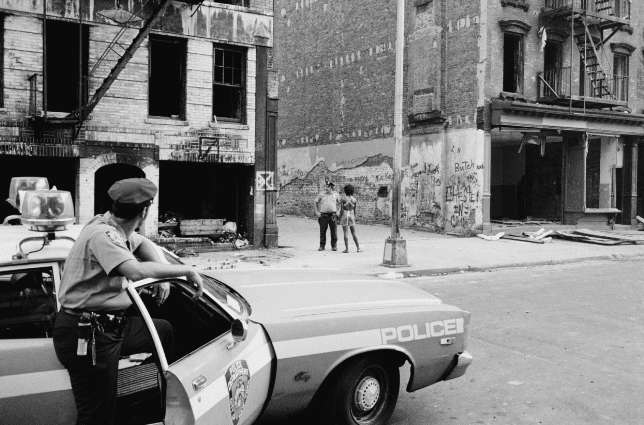
The decrease in crime was recorded only in the mid-1990s after the CompStat program was implemented. Its application proved to be effective due to the following components: accurate information, rapid deployment of all necessary resources, precise tactics and ongoing surveillance.
Subsequent police reforms included the merger of Transit Police and the NYC Housing Authority Police Department in 1996. Later, in 1998, the Police Department School Safety Division was established to improve public school safety.