

Almost everyone has heard about The New York Times at least once both in America and beyond. It is not only a daily newspaper but also a popular brand in the publishing business. This newspaper experienced many political and military shocks during its functioning. However, it was able to remain popular and maintain a high level of material quality. That is why the newspaper beloved by New Yorkers deserves recognition and respect. Read more on newyork1.
The launch of The New York Times: when and why was it started to be published in New York?
The history of this newspaper began in the 19th century. Its founder was journalist and politician Henry Jarvis Raymond. He opened a publishing house that created a daily newspaper of a new format. Its mission was to give people useful information, which was a rare case at that time. Most of the city’s newspapers published fake news, sensations and gossip because they were only interested in making money.
Thus, while other publishing houses attracted the attention of readers with scandals, Henry Jarvis Raymond’s newspaper became the first to publish real facts and inform about New York’s events. That is why the demand for the newspaper grew day by day.
In 1857, the editors decided to shorten the newspaper’s name. Since then, it has been called The New York Times. Also, after a few years, the schedule of its release changed. At first, the newspaper was published from Monday to Saturday. Then the edition started to appear on Sundays also.

The influence of the New York newspaper on society increased significantly from 1870 to 1871, especially after the publication of articles exposing the leader of the US Democratic Party, William Tweed. This led to the end of his political career.
In addition, the publishing house refused political support to expand and strengthen its independent position, preferring to develop by itself. Since that, the editorial team of the newspaper has been constantly increasing, talking about important topics for society and expanding its authority among readers.
Creation of a publishing network: how did The New York Times become well-known worldwide?
In 1896, the founder of the newspaper, Henry Jarvis Raymond, handed over the management of the publishing house to Adolph Ochs. The new manager was able to successfully popularize the newspaper outside of New York. This helped him to reach the pinnacle of informational success and make the newspaper famous all over the world.
Under the leadership of Adolph Ochs, the printing of the newspaper increased from 19,000 thousand copies to 400,000. The editorial staff worked hard to make their newspaper popular in the United States. They paid special attention to the quality of the text, analytics and the fulfillment of assigned tasks. Furthermore, they began to use new types of printing presses.

Later, the publishing house of the New York newspaper became a family business. Each new manager made changes to the work process following the trends of the 20th century.
In 1971, the newspaper published confidential Pentagon materials that influenced readers around the world. In a short time, The New York Times became an authoritative information resource, which even politicians and other famous people began to pay attention to.
In the same year, the editorial staff improved the layout of the newspaper’s pages. They created new sections and advertising blocks and began to publish more information on various topics about life in society and less about politics.
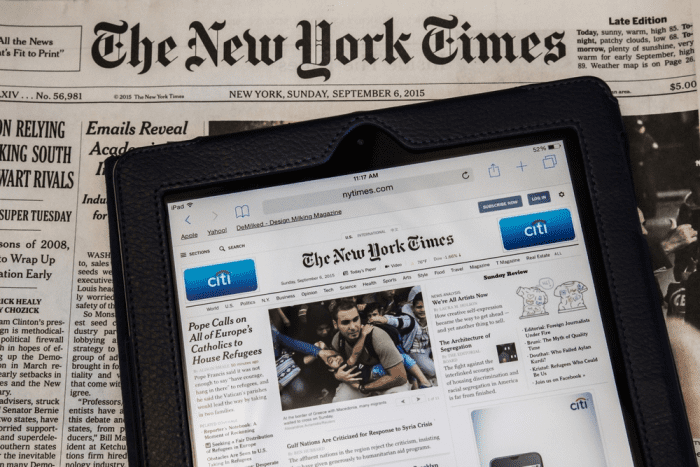
Digitalization of The New York Times
Having achieved success in publishing, the editorial staff continued to develop their activities. In 1996, they created the first online newspaper but actively began to popularize it on the Internet only in 2006. This is because the readers started to look for information more often on Internet resources than in printed newspapers.
They also developed The Times Reader application, an analogue of the printed newspaper. Journalists created many educational sections to increase interest in the newspaper. Among them is a book review, which regularly publishes reviews of books of various genres. In addition, subscribers to the online edition receive a newsletter with useful information, for example, a dessert recipe and a movie list…